


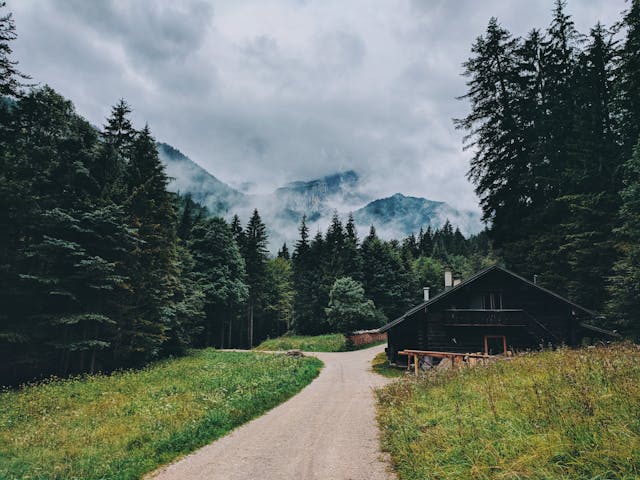
Building in the forest is a delicate and strictly regulated subject in Romania, governed mainly by the provisions of the Forest Code. This legal framework lays down the conditions under which construction can be carried out in the national forest, with an emphasis on forest protection and conservation.
The fundamental principle is laid down in Article 35 of the Forestry Code, which states that “the reduction of the area of the national forest is prohibited.” This provision reflects the importance given by the legislator to forest conservation and maintaining the integrity of the national forest fund.
However, the Forest Code provides for certain exceptions to this general rule. Article 37 lists the categories of works and objectives for which land may be permanently removed from the national forest fund. It stipulates that only land necessary for the realization or extension of the following categories of works and objectives may be permanently removed from the national forest fund, subject to compensation, without reducing the area of the forest fund and with advance payment of the financial obligations:
– exploitation of mineral resources
– tourist, leisure, religious, cultural, cemetery, sports, medical and social facilities
– dwellings or holiday homes (only in private forest land)
– objectives installed before 1990 and areas related to assets sold by Romsilva
– infrastructure (water, sewerage, energy, communications, roads)
– exploration and exploitation of mineral and energy resources.
Article 37 also lays down strict conditions for the permanent removal of land from the forest for construction purposes. For example, for dwellings or holiday homes in private forests, paragraph 2 stipulates that “the maximum area that may be subject to permanent removal from the forest estate, including construction, access and fencing, shall be a maximum of 250 square meters in the case of forest properties larger than 5 ha and a maximum of 5% of the forest estate area, but not more than 200 square meters if the forest estate area is less than 5 ha.”
An essential condition for permanent removal from the forest is compensation. According to Article 37(3), compensation is physically carried out with land that is 5 times the value of the land being permanently removed from the national forest fund, and the area of the land given in compensation may not be less than 3 times the area of the land subject to removal from the national forest fund.
The approval procedure for permanent removal or temporary occupation of land from the forest fund is detailed in Article 40. It provides that approval is given by different authorities depending on the area concerned:
- for areas up to 1 ha – the head of the specialized territorial structure of the central public authority responsible for forestry
- for areas between 1 and 10 ha – the head of the central public authority responsible for forestry
- for areas over 10 ha – the Government
Article 41 lists the financial obligations associated with the permanent removal of land from the forest estate. These include:
a) fee for permanent removal
b) the value of the land permanently removed from the national forest fund
(c) the value of the loss of growth caused by the harvesting of timber before the age of technical exploitation
(d) the value of decommissioned objectives
(e) the costs of establishment and maintenance of forest vegetation on the compensation land
Article 41(2) emphasizes that ‘the financial obligations referred to in paragraphs (1) (b)-(e) shall be paid in advance of the handover of the land for which the approval for permanent removal from the national forest fund has been issued.”.
It is important to note that according to Article 38(3), “the change of use of the objective built on the land that was subject to definitive removal from the national forest fund earlier than 5 years determines the repeal of the order of the Minister or Government Decision approving and bringing the land removed from the forest fund to its original state at the expense of the beneficiary of the approval.”
In conclusion, although building in the forest is possible in certain situations, the process is complex, costly and strictly regulated. The current legal framework reflects a conservative approach, prioritizing the protection and conservation of the national forest fund. For those considering building in the forest, it is necessary to fully understand the legal, financial and environmental implications of such a project, and to consult with legal specialists and competent forestry authorities to initiate and finalize the procedure.


